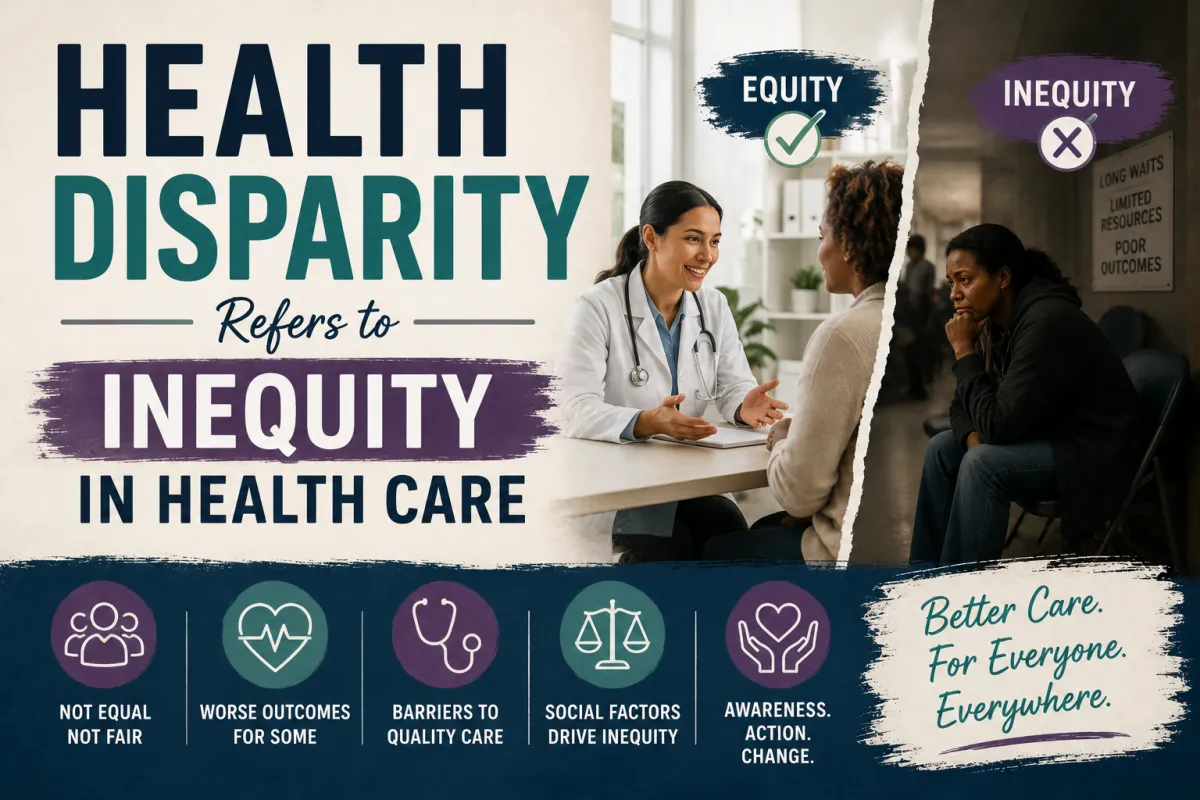
Health Disparity Refers to Inequity in Health Care

Health outcomes are influenced by a wide range of factors known as social determinants, including but not limited to lack of access to resources, unpleasant and discriminatory procedures, and lack of education, income, employment, and housing. These extraneous variables explain why some people's health is better than others. A health disparity refers to inequity in health care. For instance, compared to white moms, black mothers have a significantly lower chance of receiving adequate prenatal care and are nearly three times more likely to die after childbirth. There's no explanation for this on a biological level, yet black women have long been the target of medical bigotry. This disparity exemplifies racial inequality, which may be defined as the unjust and unequal allocation of resources along racial lines and is particularly problematic when adding to existing health inequalities.
The American Public Health Association (APHA) reports that discrimination and prejudice may be open, terrifying, and devastating. For instance, 53% of African Americans and 36% of Latinos reported being mistreated in the Kaiser Family Foundation/CNN Survey of Americans on Race. Researchers supported by the National Institutes of Health have also looked at the impacts of interpersonal racism and prejudice. They've discovered strong links to mental health symptoms, drug use behavior, cardiovascular events, and general physical function.

In the realm of public health, a similar scenario exists, with certain individuals having unfettered access to all available resources and services. Providing healthcare, clean water, secure housing, an education, and a living salary are all challenges for others. This implies that some populations are more vulnerable to disease yet have less access to healthcare, increasing the likelihood that they may get very ill or pass away due to potentially avoidable causes of death.
The Doctorate of Behavioral Health (DBH) has a unique and vital responsibility to address structural racism and end racial inequities. Unfortunately, people who have not experienced the harsh effects of structural racism have acclimated to it, tolerated it, and benefited from it. Therefore, we must identify, modify, or eradicate policies that support structural racism wherever it exists.
In other words, encouraging healthy lifestyles alone will not end these and other health inequalities. Better action is needed by public health agencies and their partners in fields including education, transportation, and housing to address the underlying causes of poor environmental conditions.
Did you find the information listed in this article helpful? Leave a comment below, I’d love to know what you think.
If you enjoyed this article, share it with your friends and colleagues!